

December 23, 2022
AXEM Technology : a partner of GS1 France to better support organizations in improving their logistics processes
CSR and logistics
Corporate Social Responsibility (CSR) refers to companies’ contributions to sustainable development issues. As defined by the international standard ISO 26000, CSR encompasses seven areas of action: governance, human rights, society, the environment, fair operating practices, consumer issues, and community engagement.
In this standard, logistics encompasses all operations related to the physical flow of goods, including transportation, storage, handling, and packaging.
A supply chain accounts for the largest portion of a company’s environmental impact. According to a PwC study, optimizing data collection and using artificial intelligence could potentially reduce greenhouse gas emissions by up to 4% by 2030 [1] .
AXEM Technology , for example, offers traceability solutions to help companies adopt a “ CSR ” approach to logistics.
Improving the Supply Chain to Enhance a Company's Overall Performance

Adopting a “ CSR ” approach to logistics helps improve a company’s economic, social, and environmental performance. It also helps meet the expectations of stakeholders—primarily customers—who are increasingly concerned about their suppliers’ social responsibility.
The study on sustainable consumption conducted by Oney between 2020 and 2021 confirms that 90% of consumers in Europe want brands to take action and help them consume more responsibly [2].
Another study conducted by Deloitte in 2021 highlights that 60% of consumers consider sustainability in their purchasing decisions, particularly ethical sourcing and the environmental impact of materials [3].
So, it doesn’t take much to realize that improving the environmental impact of one’s business—and thus of its supply chain—is now a necessity, especially since it helps improve the company’s overall performance.
Therefore, to achieve sustainability goals, companies must use traceability solutions and data analysis.
In fact, there are several types of benefits that can be derived from improving data processing:
– Optimize production methods
– Transforming the linear economy into a circular economy
– Improve customer service levels and thereby ensure a positive customer experience
– Managing Health Risks
– Improve the flow of goods and achieve economies of scale
– Protect customer/consumer data.
GS1: The Keys to Maximizing Data Management
The standardization of barcodes has become widespread since their introduction in 1974 on a food product in the United States.
However, GS1 is keeping pace with technological advances and is beginning to establish standards for RFID, which is increasingly used for identifying goods in the industry. This new type of identification has become necessary as connectivity becomes more widespread.
Thus, with the GS1 standard, companies can uniquely and internationally identify their products, logistics units, sites, and entities.
In fact, GS1 standards make it possible to:
- List Your Products and Your Business
- Digitize your products and provide high-quality information
- Automate business transactions from order placement to invoicing
- Optimize logistics processes by streamlining receiving, shipping, and inventory management
- Improve the visibility of your supply chain by tracking your flows and products.
AXEM Technology is part of the GS1 partner network.

“Our goal is to master GS1 standards so we can offer the best support and the right products to our customers”—Philippe MONDON, CEO ofAXEM Technology.
AXEM Technology offers comprehensive support for the implementation of traceability solutions and the optimization of industrial processes
AXEM Technology , an RFID manufacturer and expert, offers RFID tags, readers, mobile terminals, and industrial RFID equipment tailored to the most demanding industrial sectors.
How does AXEM Technology support you?
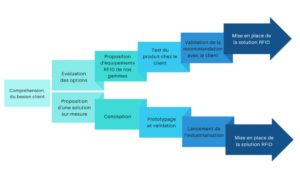
Figure 1: The different stages of customer support provided by AXEM Technology
About GS1 France

GS1 France is an international standards organization created by businesses to facilitate the exchange of information and trade.
The best-known standard created by GS1 is the GTIN (Global Trade Item Number), a 13-digit product code and its symbol, the barcode, used by companies to uniquely and consistently identify their products. This allows them to sell their products in stores and/or online worldwide.
Today, GS1 offers solutions for standardizing product traceability using RFID, particularly through the EPC standard.
And that's where AXEM Technology, an expert RFID manufacturer, brings its expertise and experience to bear.
References:
[1] https://www.connaissancedesenergies.org/afp/climat-le-numerique-pointe-du-doigt-pourrait-aussi-permettre-de-reduire-des-emissions-de-gaz-effet-de-serre-211011
[2] https://www.oney.com/etude-consommation-raisonnee/
[3] https://www2.deloitte.com/content/dam/Deloitte/fr/Documents/consumer-business/etude_Deloitte_2021_sur_l%E2%80%99industrie_horlogerie.pdf